 16:9 · 1664×936 · OpenAI image generation (model unspecified)
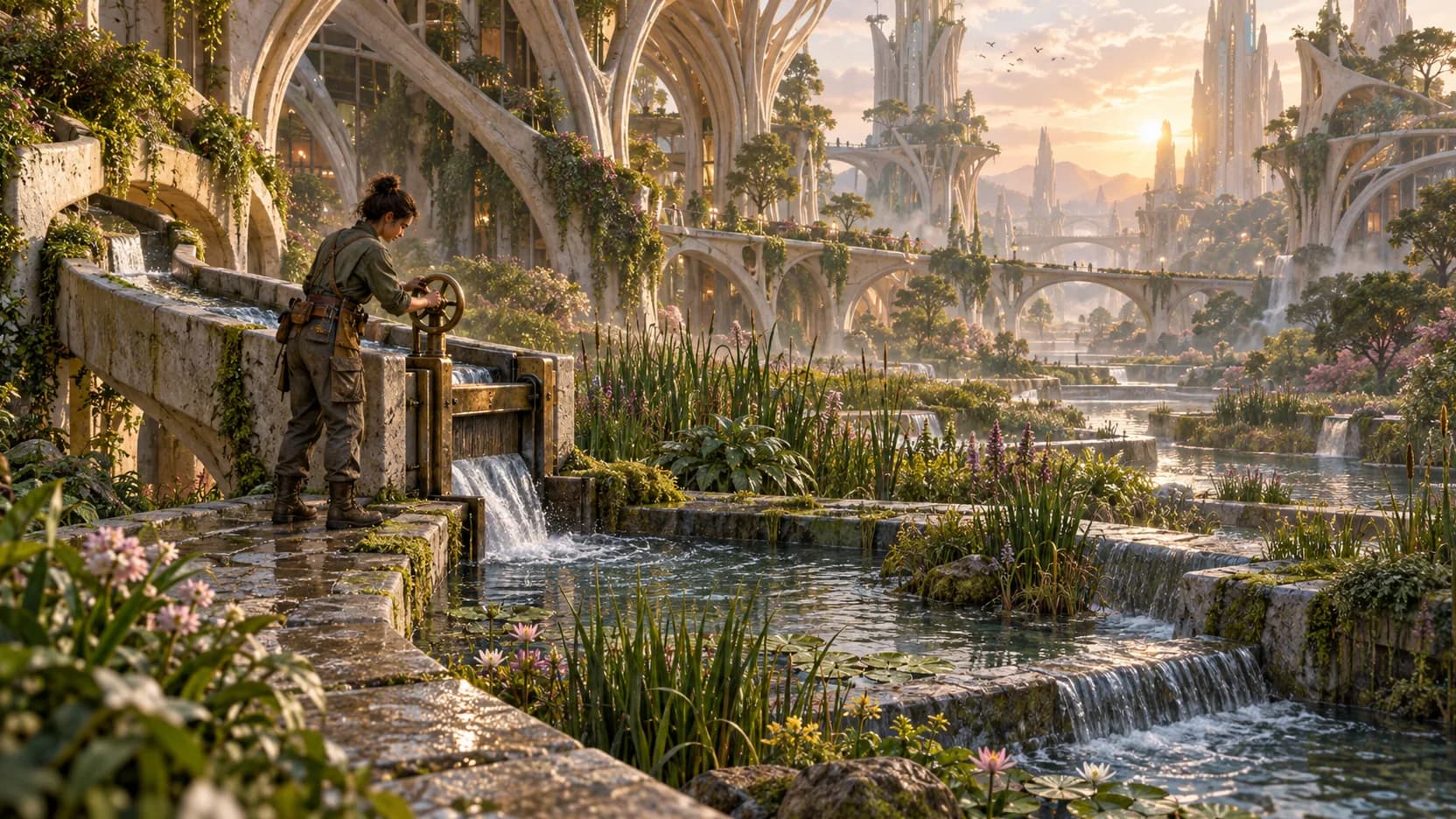
A caretaker turns a brass handwheel beside an open water channel. Below the gate, a short cascade feeds a shallow pool edged with reeds, moss and pink flowers. More pools step down through the city, their low stone walls catching the morning light. The water leads the eye from the machinery in the foreground to a sequence of bridges in the distance.
Pale structural ribs rise around this working landscape. Their branching supports suggest trunks and roots, but windows and occupied walkways keep the architecture recognizably urban. Trees spread across the terraces above. Warm light catches the edges of the arches while the lower channels remain cool and green.
The scene imagines rainwater management as part of a city’s everyday public space. Its biopunk architecture supplies the unfamiliar forms; the handwheel, worn boots and damp masonry give those forms a human scale. Someone still has to tend the system. The caretaker is doing that work, close enough for the mechanism to matter as much as the skyline.
This is speculative AI artwork, not a drawing of an engineered treatment system. The planted basins suggest a wetland-inspired approach to moving and holding water, without establishing purification performance. The image’s central proposition is simpler: a future city could make its water infrastructure visible, cared for and worth looking at.
Use case: stylized-concept.
Create ONE finished standalone artwork for Slaacr, titled conceptually "The Biopunk Rainwater Exchange", with no text printed in the image. Landscape 16:9 composition.
Scene: an inhabited future city whose architecture has grown into pale ribbed organic arches and branching buttress towers. At ground level, rain collected by the buildings runs through clearly connected channels into a succession of shallow terraced wetland pools. Sedges, reeds, water-loving flowers and patches of moss grow in the filtration terraces. Make the water system physically readable: higher collecting channel, a controllable sluice, then stepped pools descending into the distance.
Focal action: one adult caretaker in practical weathered work clothes turns the brass handwheel of a modest sluice gate on a safe stone walkway beside the nearest pool. The caretaker and flowing water establish human scale, with coherent anatomy and a credible supported mechanism. The ecological infrastructure is the main subject, not a generic distant skyline.
Composition: wide establishing shot from human eye level, clear foreground-to-background depth, strong ribbed arch silhouette, caretaker and sluice near a rule-of-thirds intersection, gently curving channels guide the eye through the frame. Balance monumental living architecture with intimate daily maintenance. Keep important subjects clear of the extreme edges.
Style: solarpunk aesthetic with biopunk undertones; hyperrealistic yet painterly editorial concept art, finely observed porous mineral surfaces, worn brass, damp stone, subtle plant textures, lush integrated nature. Dawn just after rain, warm backlighting, soft volumetric atmosphere, muted earth tones punctuated by emerald and rose gold, restrained soft film grain. An optimistic, thoughtfully maintained future with signs of real use, not sterile luxury or a video-game screenshot.
No text, captions, logos, watermark, decorative holographic UI, giant planets, gratuitous neon, impossible waterfalls, disconnected pipes, duplicated people or split panels.