 16:9 · 941×529 · DALL-E 3
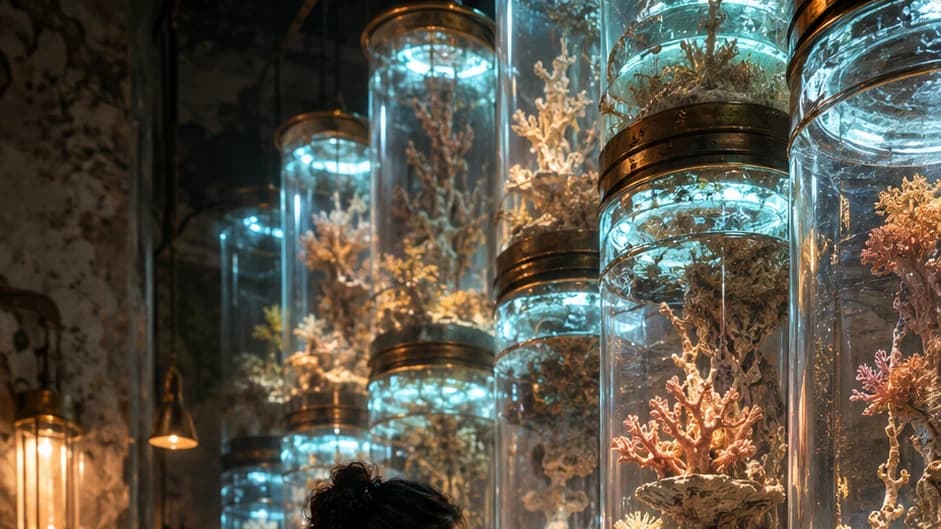
A biopunk coral restoration sanctuary, late afternoon. Tall translucent glass cylinders rise from a wooden bench along one wall — each cylinder is a vertical reef garden, its interior packed with fragments of pink, gold, and tan coral growing on intricate ceramic substrates. Warm amber LEDs at the cylinder bases throw the coral into reverse silhouette. A young researcher in dark cream linen smock stands at the central cylinder, mid-action, brush in hand — she's cleaning algae from one of the corals, the way you'd dust a houseplant's leaves. The foreground holds a wide hand-bound observation logbook, opened to a page of careful botanical-style coral sketches; below them, in a smaller cursive, calibration notes and dates.
Coral restoration is real applied science. SECORE International and the Australian Institute of Marine Science (AIMS) have run assisted-evolution programs since the early 2010s, breeding heat-tolerant coral strains and outplanting fragments to degraded reefs. The Coral Restoration Foundation has planted over 250,000 corals on Florida reefs. The image extends the practice into an architectural sanctuary — vertical glass aquaria rather than horizontal nursery tables — and back into the older naturalist tradition: a hand-drawn logbook in place of a CSV. The argument is for the kind of long, slow, observation-based work that climate-resilient reef restoration actually requires.
The interior of a biopunk coral restoration sanctuary at dusk,
vertical composition. Tall translucent bio-glass tanks rise floor-to-
ceiling along the back wall, each containing assisted-evolution coral
fragments — tans, pinks, golds — growing on intricate hand-shaped
ceramic substrates. Bioluminescent bacterial cultures glow softly along
the tank rims in pale cyan, supplementing warm-amber LEDs. Middle: a
researcher in a linen smock tends one of the central tanks with a long
brass tool, focused expression, hands steady. Foreground: a low slate
workbench with a hand-bound observation logbook, ceramic ink pots, a
calibration pipette. Ferns in stone troughs along the side wall.
Atmospheric warm-cool palette. Biopunk research-sanctuary aesthetic.
Avoid: sterile sci-fi lab; aquarium-store look; lab coats and
clipboards-as-props clichés.