 16:9 · 1792×1024 · DALL-E 3
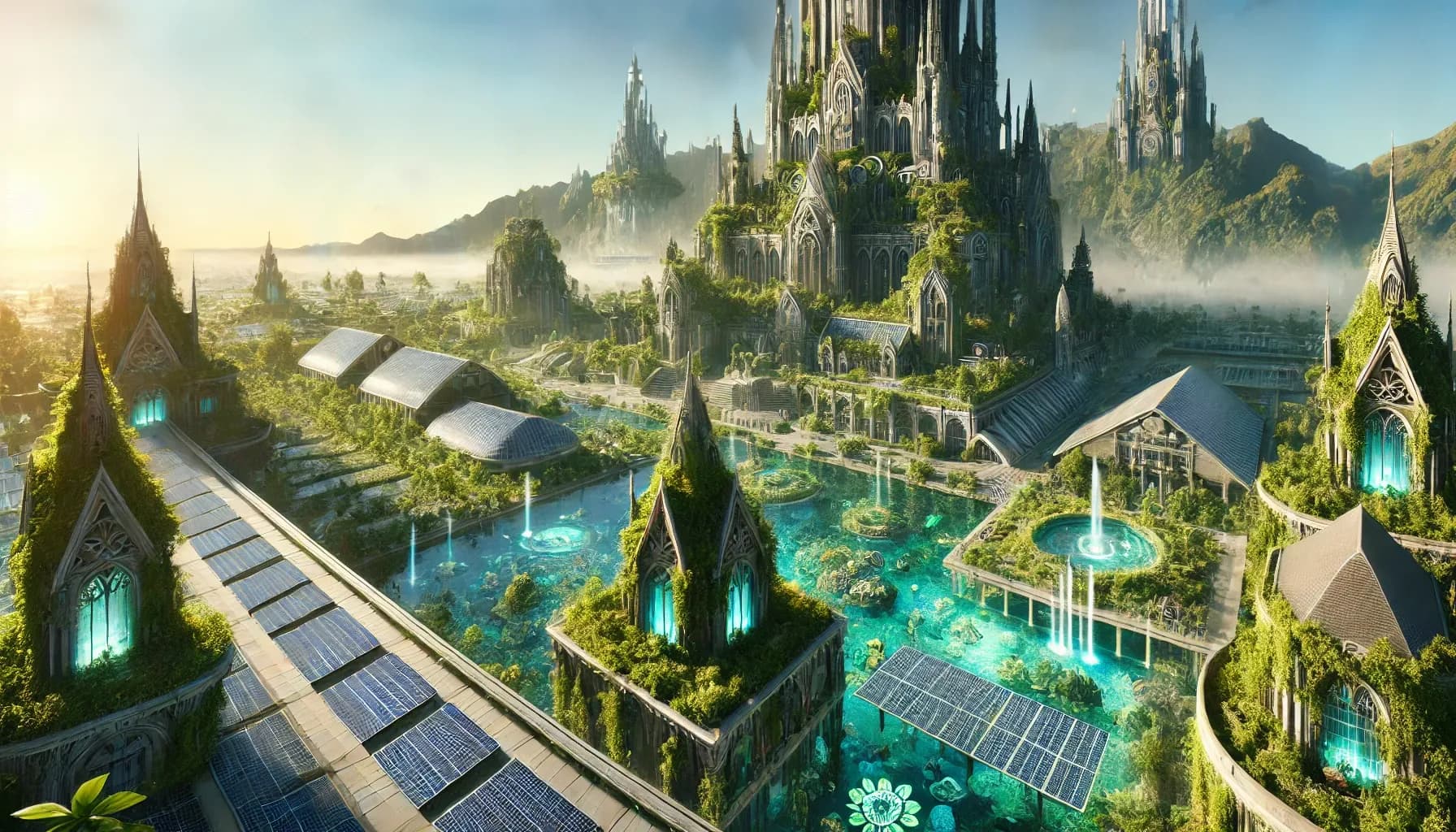
The image's architecture is unusually specific. A cluster of high gothic-cathedral spires rises in the middle distance — vine-cloaked stone, narrow vertical windows, the silhouette of late-Gothic European church-building. In the foreground, a series of small angular pavilion-buildings with steep solar-paneled roofs flanks a series of teal-cyan glowing fountains. Vines climb every surface. Mountains rise in the haze behind the cathedral cluster. The light is bright daylight, possibly midday.
The pairing of late-Gothic spires with solar-paneled pavilions is unusual but not arbitrary. Gothic architecture solved a specific structural problem — making large internal volumes possible without medieval-era engineering's load-bearing limits — through pointed arches, ribbed vaults, and flying buttresses. The solution had nothing to do with energy. But once you have these large internal volumes, you also have generous south-facing roof surfaces where the steep gable provides ideal solar incidence angles in temperate latitudes. Real European cathedrals have started installing photovoltaics on these surfaces over the last decade. The Notre-Dame de Paris reconstruction (post-2019 fire) considered solar-integrated lead alternatives. King's College Chapel in Cambridge installed roof panels in 2023 after a long heritage-debate.
The cyan-glowing fountains at the foreground are the gallery-fictional element. Real cathedrals don't have these. The fountains read either as data-streams (information flowing through the city), as some kind of geothermal vent (heat and possibly power), or as stylized water features (decorative). The image is willing to leave the ambiguity. What it commits to is the broader proposition: a sustainable city that takes Gothic cathedral architecture seriously isn't impossible. The roofs are already correctly oriented. Someone just has to put the panels on.
This image was imported from the original Slaacr library. The DALL-E prompt was not documented at creation time. It's pending regeneration through the Studio's SAE master template — once that happens, the prompt will appear here as a teaching artifact.