 16:9 · 941×529 · DALL-E 3
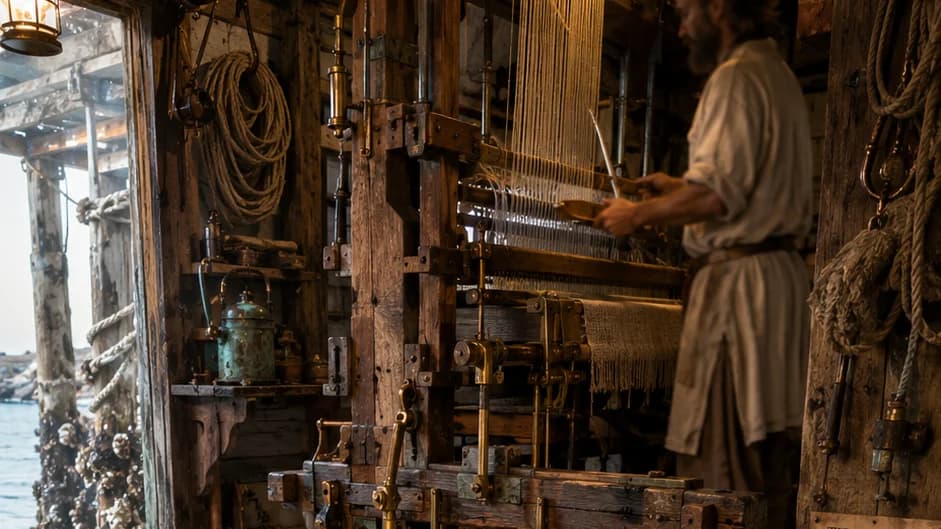
An oceanpunk weaver's workshop on a salt-bleached dock, late afternoon. Through a glass hatch in the floor: a massive brass tidal mechanism, its gears submerged in glowing turquoise water and turning slowly with the rising tide. The mechanism connects upward through polished brass linkages to a large warp-weighted loom in the middle of the room — every thread tensioned by tide-driven motion. The weaver, in linen tunic and tan apron, stands at the loom adjusting a shuttle.
Coiled hemp ropes hang from pegs along the timber walls. Oyster shells encrust the dock pilings visible through the open side window. A brass hanging lamp throws warm gold onto the workbench. The water below the hatch is the cold-blue of clean tropical shallows; the room light is golden afternoon. The contrast is the point.
Tidal mills are real architecture. The Eling Tide Mill in Hampshire, England has operated since 1418 — one of two still working in the UK. Faroese stone tidal mills date to the medieval Norse settlements. The image extends the same principle — using the predictable rise and fall of the sea as a power source — into a more delicate craft application: a weaving studio rather than a grain mill. Slow energy, slow textile, no electrical grid involvement at all.
The interior of a small wooden workshop built on a salt-bleached dock,
late afternoon. Vertical composition: floor hatch in the foreground
revealing the tidal mechanism (brass gears turning slowly with the rising
tide), a large wooden loom rising in the middle ground with its warp
threads stretched taut, polished brass linkages connecting the pedals to
the gears below. A weaver in a linen tunic stands at the loom adjusting a
shuttle, in soft focus. Walls hung with coiled ropes; oyster shells
encrusting visible dock pilings outside an open side window; copper
fittings green with patina. Warm gold light from the door, cool blue from
the tidal hatch. Oceanpunk craft realism, weathered.
Avoid: sci-fi machinery; perfect cleanliness; cartoon ocean.

---