 16:9 · 1792×1024 · DALL-E 3
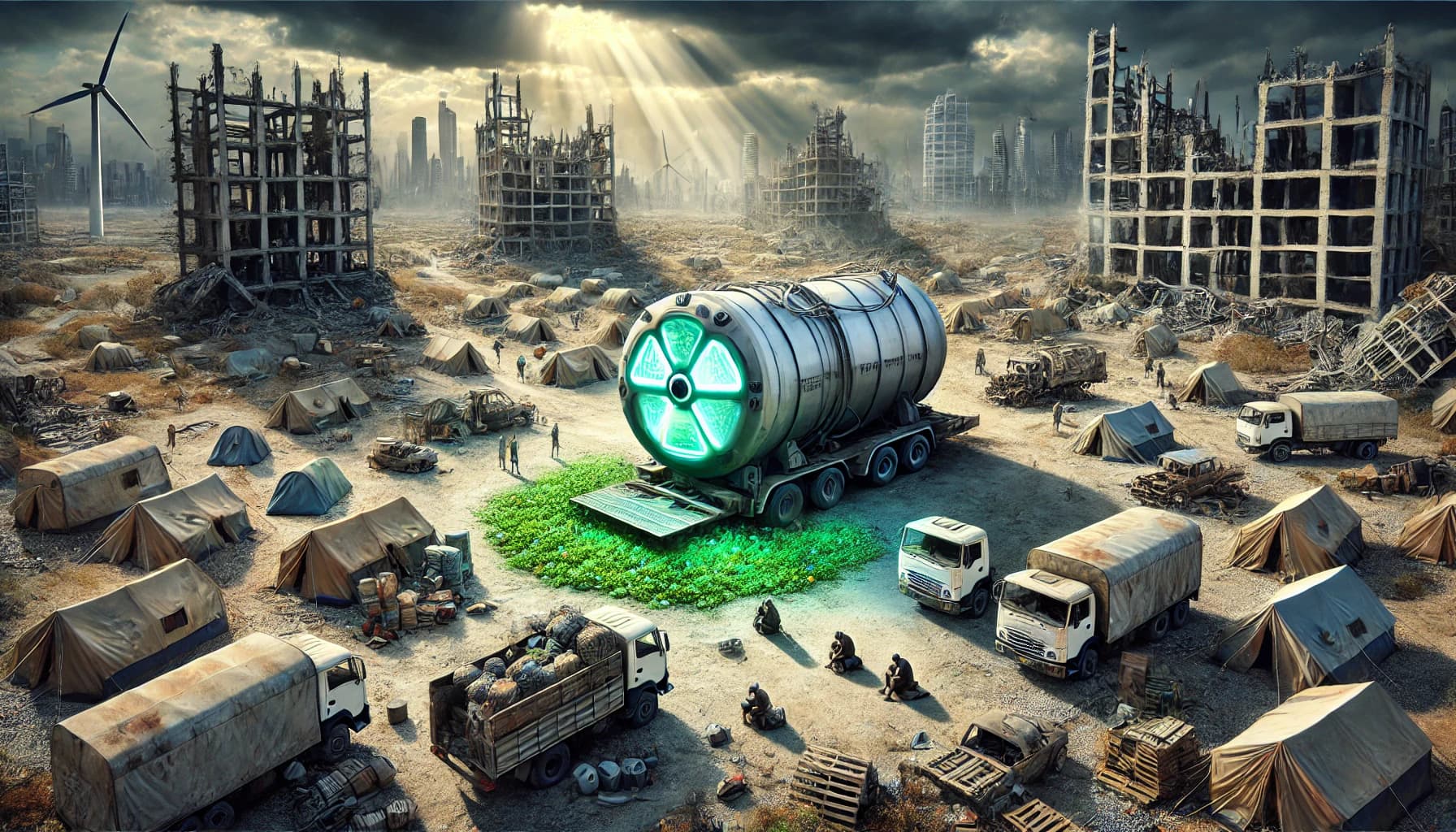
The composition is a bird's-eye view of a refugee encampment. Tan canvas tents and wooden shipping crates spread across a dusty plain. The skeletons of two ruined high-rise buildings rise on either side of the frame. A single wind turbine spins in the far middle distance. At the visual center sits a long cylindrical tank on wheels, painted military-grey, a green glowing porthole on its side. Around its base, a small patch of vivid green — grass, vegetable beds, an oasis the size of a backyard. Survivors scaled small move between the tents and the device.
The device is a small modular reactor. Real SMRs exist. NuScale Power received the first US Nuclear Regulatory Commission design certification for a commercial SMR in 2023. The Russian KLT-40S has been operating on the Akademik Lomonosov, a floating nuclear plant in the Arctic, since 2020. The Chinese ACP100 is in commercial construction. SMRs are designed to be roughly truck-deliverable, factory-prefabricated, and grid-independent — exactly what this image is showing. The post-apocalyptic frame is the speculative move. The truck-deployable reactor is not.
What the image quietly argues is that nuclear has a humanitarian use case that doesn't get talked about much. After major disasters — Hurricane Maria in Puerto Rico, the Tohoku earthquake in Japan, the Mozambican floods of 2019 — restoring grid power is months-long work. A reactor that can be delivered on a truck, set up in days, and run a small encampment for years is genuinely a different shape of solution. The image's wind turbine in the distance is the honest disclosure that this isn't either-or. The SMR is supplementing, not replacing.
This image was imported from the original Slaacr library. The DALL-E prompt was not documented at creation time. It's pending regeneration through the Studio's SAE master template — once that happens, the prompt will appear here as a teaching artifact.