 16:9 · 1254×705 · DALL-E 3
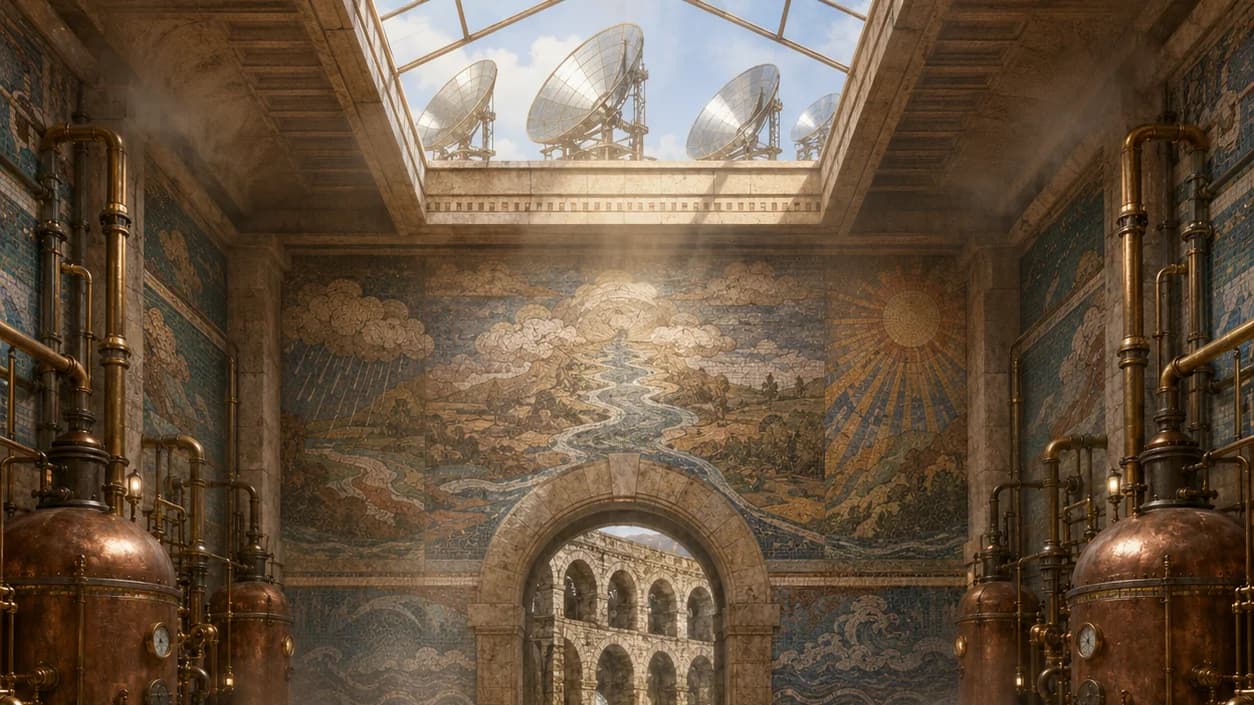
A clockpunk-eco public bathhouse, the interior of a vaulted hall lit by skylights through which parabolic solar concentrators are visible against blue sky. Two large copper boilers flank the room, copper piping rising along the side walls connecting them to the steaming pool that fills the room's center. The walls behind the boilers are covered in detailed mosaics depicting the water cycle — rain falling onto mountains, rivers descending, an aqueduct arching through a city, sun rays radiating overhead. Through an arched portal in the back wall: a Roman-style stone aqueduct visible in the distance, with water cascading over a stepped weir. Several bathers — men and women, varied ages — soak in the pool. The floor in the foreground is a swirling tessellated mosaic.
Roman bathhouse architecture is one of the most copy-tested public-space designs in history. The Baths of Caracalla (Rome, 216 CE) and Diocletian's Thermae (306 CE) operated at scales modern wellness centers don't approach — Caracalla served 1,600 bathers simultaneously. The image extends the architectural language with steampunk additions: visible copper boilers (rather than buried heating), solar concentrators in the skylight (rather than wood-burning hypocaust), water-cycle mosaics on every wall as instruction. The argument is that thermal bathing should be municipal infrastructure again — heated by sun and visible mechanism, free or near-free at the point of use.
The interior of a neighborhood bathhouse driven by a Roman-style stone aqueduct that enters through the back wall, photographed from a balcony looking down. A large rectangular soaking pool dominates the floor; several bathers of varied ages relax in the water. Brass pipes carry heated water from copper boilers along the side wall; the boilers are fed by solar concentrator mirrors visible through a high skylight. Tile mosaics on the floor and walls depict the water cycle — clouds, rain, river, sea, sun — in muted blues, golds, terracotta. Steam in the air, soft warm light, the gentle ambient blur of moisture. Clockpunk sensibility: visible mechanism, no hidden tech. Painterly realism.

Avoid: ornate Victorian excess; readable mosaic narrative panels.