 16:9 · 1792×1024 · DALL-E 3
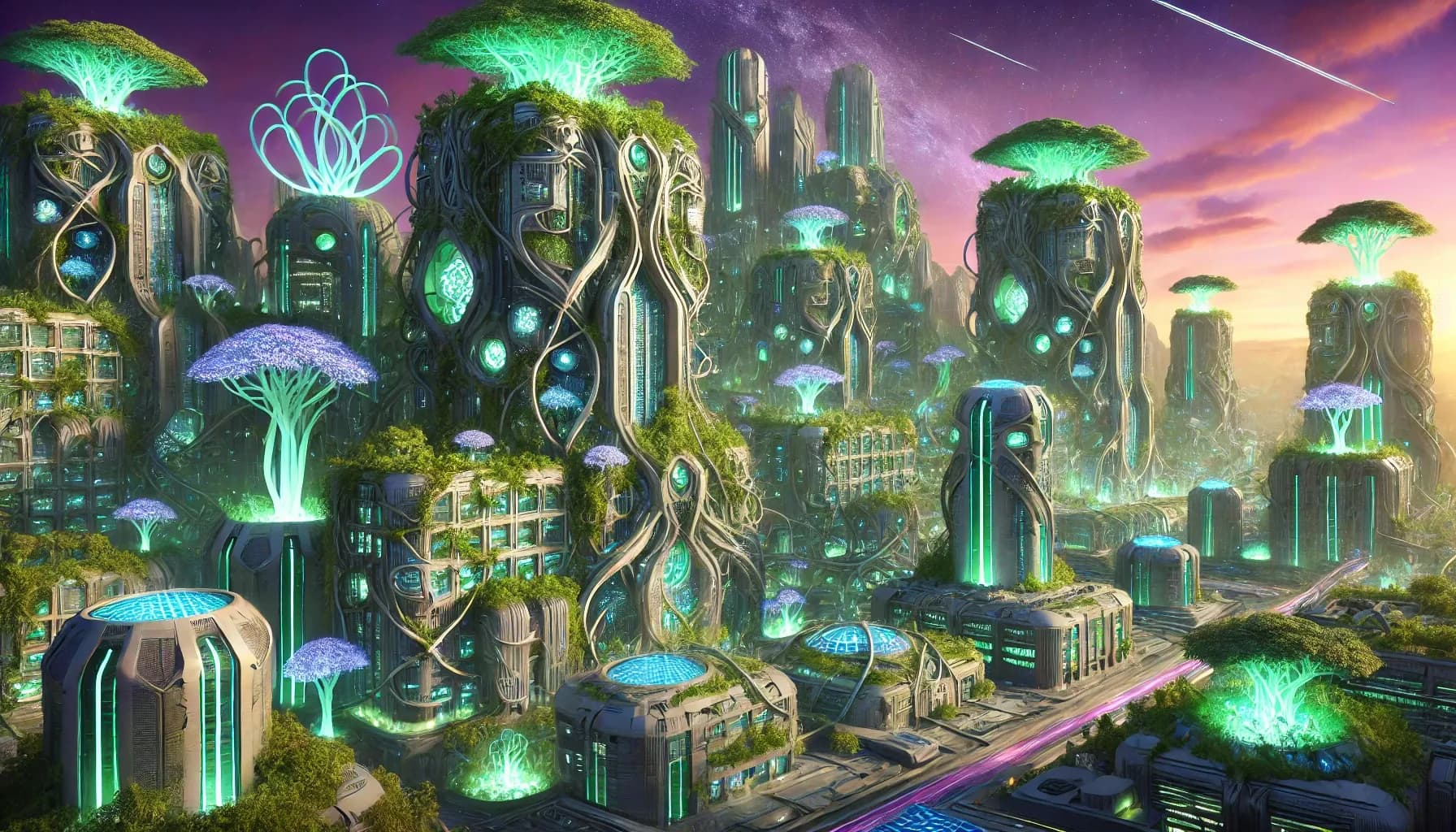
What's distinct about this image is that the architecture isn't a collection of separate buildings. It's a continuous structure — towers, walls, terraces, vines all flow into each other without obvious seams. The whole city reads as one large organism that has subdivided itself into something like apartments. Mushroom-shaped tree-towers cluster at every elevation. Glowing teal cores pulse from inside the bigger forms. Pink and white blossoms cap the highest points. A large moon hangs in a violet sky.
The continuous-organism reading has biological precedent. Coral reefs are continuous structures from a polyp's perspective — the calcium architecture of the reef is, technically, a single secreted body produced by the colony. Slime molds (Physarum polycephalum) form continuous organisms that operate as both individual cells and unified plasmodial bodies; they've famously been shown to optimize transport networks the way well-designed cities do. The image is closer to a coral or a slime mold than to a master-planned development. Whatever this is, it grew.
The argument the image makes is that 'sustainable city' might be the wrong category. The category that fits better is 'organism that takes the shape of a city.' That's a different design philosophy. A city, in the conventional sense, is built — by humans, with materials, on a schedule. An organism that takes the shape of a city is grown — by some biological process, over time, with its own logic. The first can be planned and rebuilt. The second can be cultivated, adjusted, but not really redesigned. The image is willing to ask which kind of place would be more pleasant to live in. The answer the violet sky suggests is: this one, on a good evening.
This image was imported from the original Slaacr library. The DALL-E prompt was not documented at creation time. It's pending regeneration through the Studio's SAE master template — once that happens, the prompt will appear here as a teaching artifact.