 16:9 · 1792×1024 · DALL-E 3
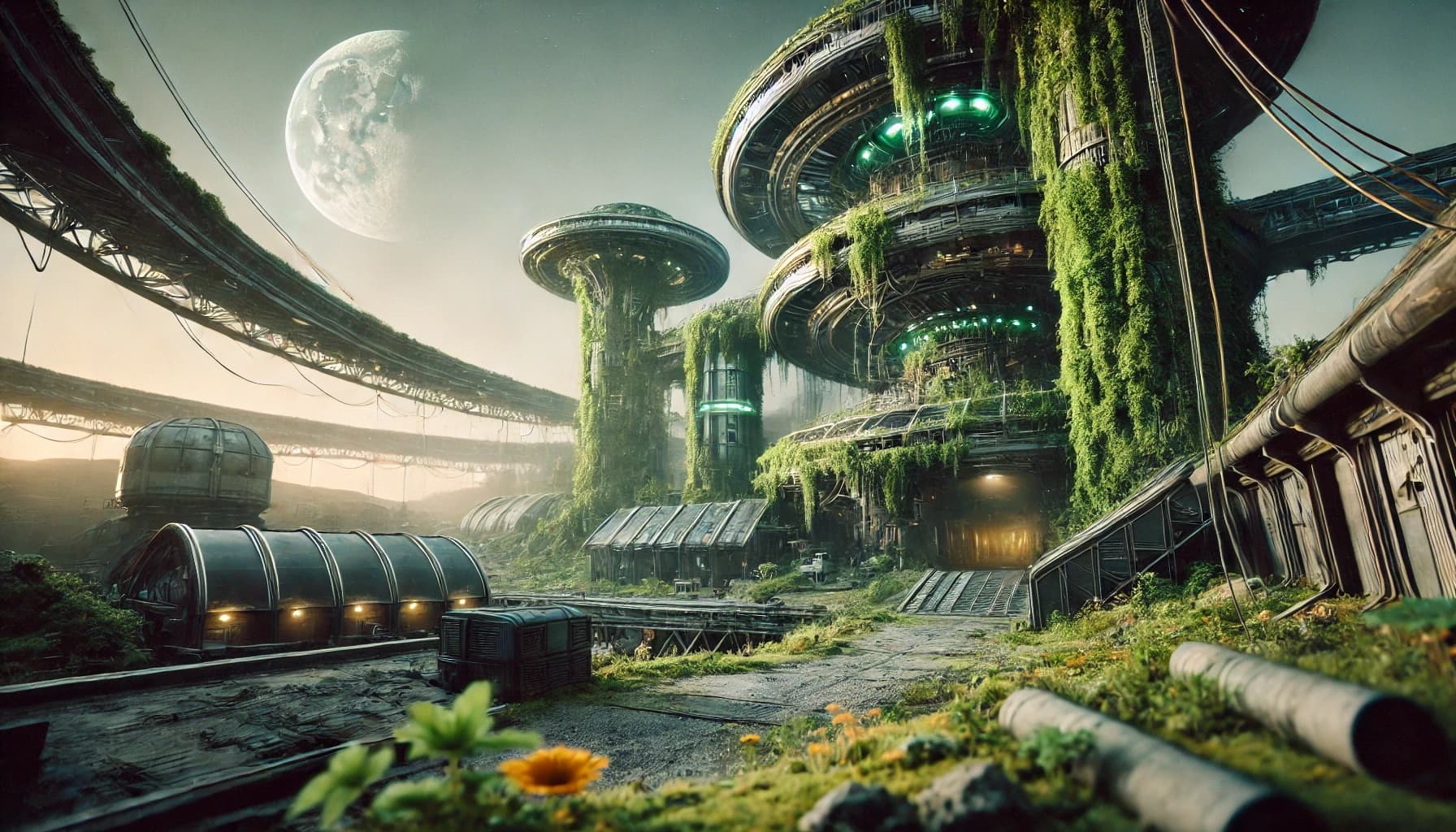
What this image actually shows is closer to abandoned-and-overgrown than to thriving-and-sustainable. Three or four mushroom-shaped buildings — flat circular crowns supported on thick central pillars — stand among broken pipes and rusting infrastructure on a rocky alien plain. Vines and grasses spill down every visible surface. A single yellow sunflower blooms in the lower foreground, its bright color almost startling against the muted earth-tones around it. A massive moon hangs in the haze on the upper-left. The buildings have lights still on inside; some kind of life is still happening here.
The overgrown-outpost trope is well-established in science fiction. Ridley Scott's Alien (1979) opens on a similar derelict-outpost staging. Andrei Tarkovsky's Stalker (1979) operates in adjacent visual territory. More recently, the 'comfy abandoned' aesthetic in games like Death Stranding, Outer Wilds, and No Man's Sky uses the same composition: humanoid infrastructure being slowly recovered by alien plant life, with one small sign (a flower, a song, a light) that something is still here.
The sunflower is the editorial touch. Sunflowers don't grow here naturally. Whoever lives in this outpost planted it. That detail does most of the image's argumentative work. 'Sustainable architecture on an exo-planet' isn't, in this image, a glittering megastructure. It's a small set of mushroom-shaped buildings with the lights still on, surrounded by alien grass that has decided the place is fine, with one yellow flower that someone — presumably human — chose to plant in the dirt. That's what sustainability looks like over a long enough time horizon. Things grow. Some of them are grown on purpose.
This image was imported from the original Slaacr library. The DALL-E prompt was not documented at creation time. It's pending regeneration through the Studio's SAE master template — once that happens, the prompt will appear here as a teaching artifact.