 16:9 · 1792×1024 · DALL-E 3
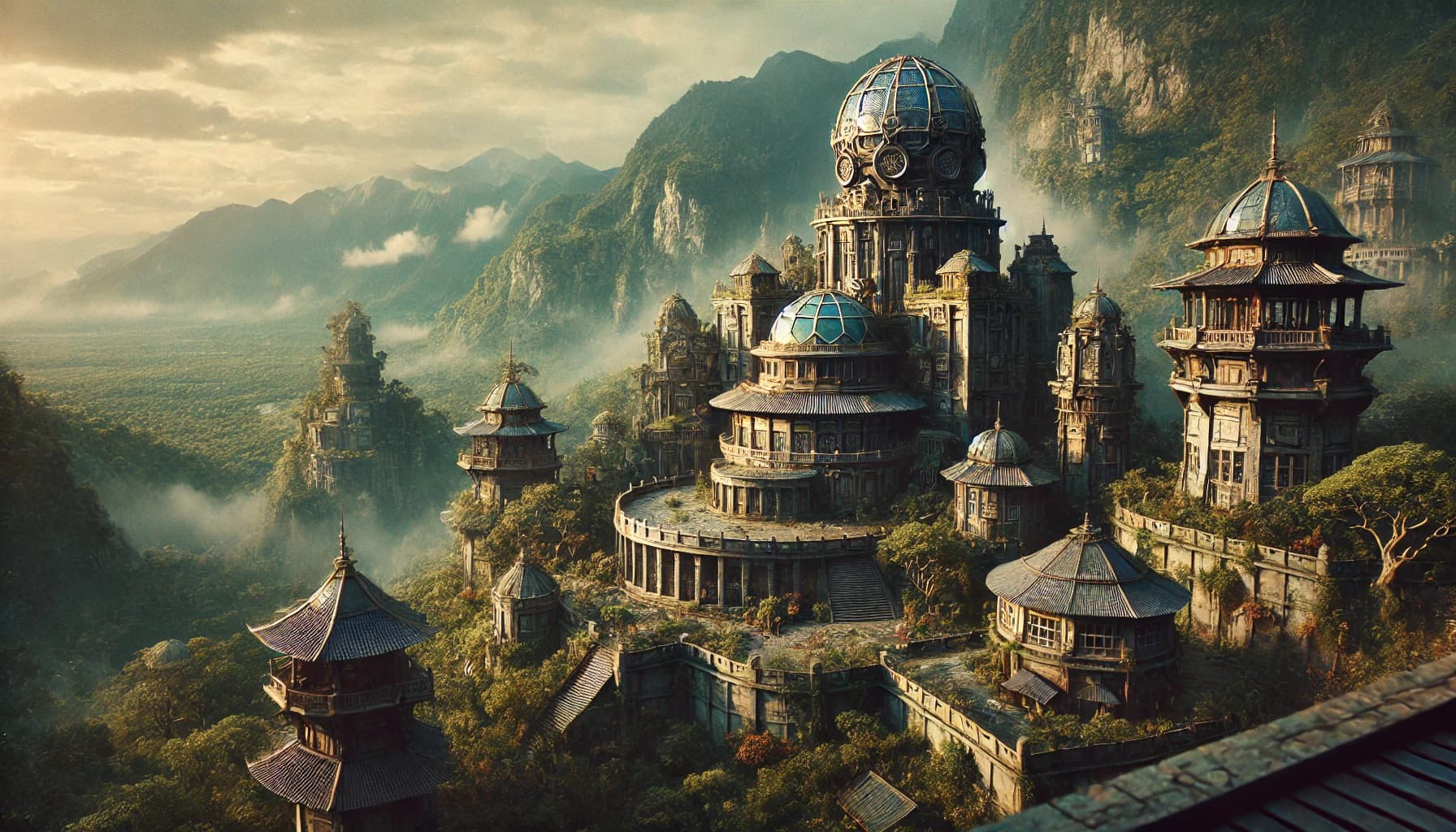
The image is elegiac more than utopian. A complex of stone-and-tile domed buildings — three or four storeys each, with onion-cap rooftops and arched window frames — sits on a mountainside ridge wrapped in mist. The architecture pulls from Bukharan, Khorezmian, and Ottoman sources, but the buildings are visibly weathered. Vines climb the lower walls. Tiles are missing in places. The largest dome on the upper ridge has a cracked seam. There are no visible inhabitants in the frame.
The gallery copy frames this as a thriving city, but the image itself doesn't agree. What it shows is closer to Bagan after the abandonment, or Angkor Wat in the centuries between Khmer-empire collapse and 19th-century re-encounter — a built environment that is still intact, still recognizable, but no longer populated. The mountains in the background are the same Himalayan-foothill register as Mustang in Nepal or the Spiti Valley in Himachal Pradesh: high, misted, quiet, with cultures that are mostly older than the question of whether they're 'sustainable.'
The medieval-solarpunk frame is therefore interesting in a different way than the gallery title suggests. The image's argument seems to be that solarpunk doesn't require a thriving population to be visible. The stone domes don't have solar panels on them. The architecture is simply correct — high windows for light, thick walls for thermal mass, dome geometry for structural efficiency. Real Central Asian medieval architecture solved the climate-and-energy problem with masonry and orientation rather than electricity, and many of those buildings still work. The image proposes that 'medieval solarpunk' might just mean: buildings that don't need anything, in a place that doesn't need them either.
This image was imported from the original Slaacr library. The DALL-E prompt was not documented at creation time. It's pending regeneration through the Studio's SAE master template — once that happens, the prompt will appear here as a teaching artifact.