
 16:9 · 1792×1024 · DALL-E 3
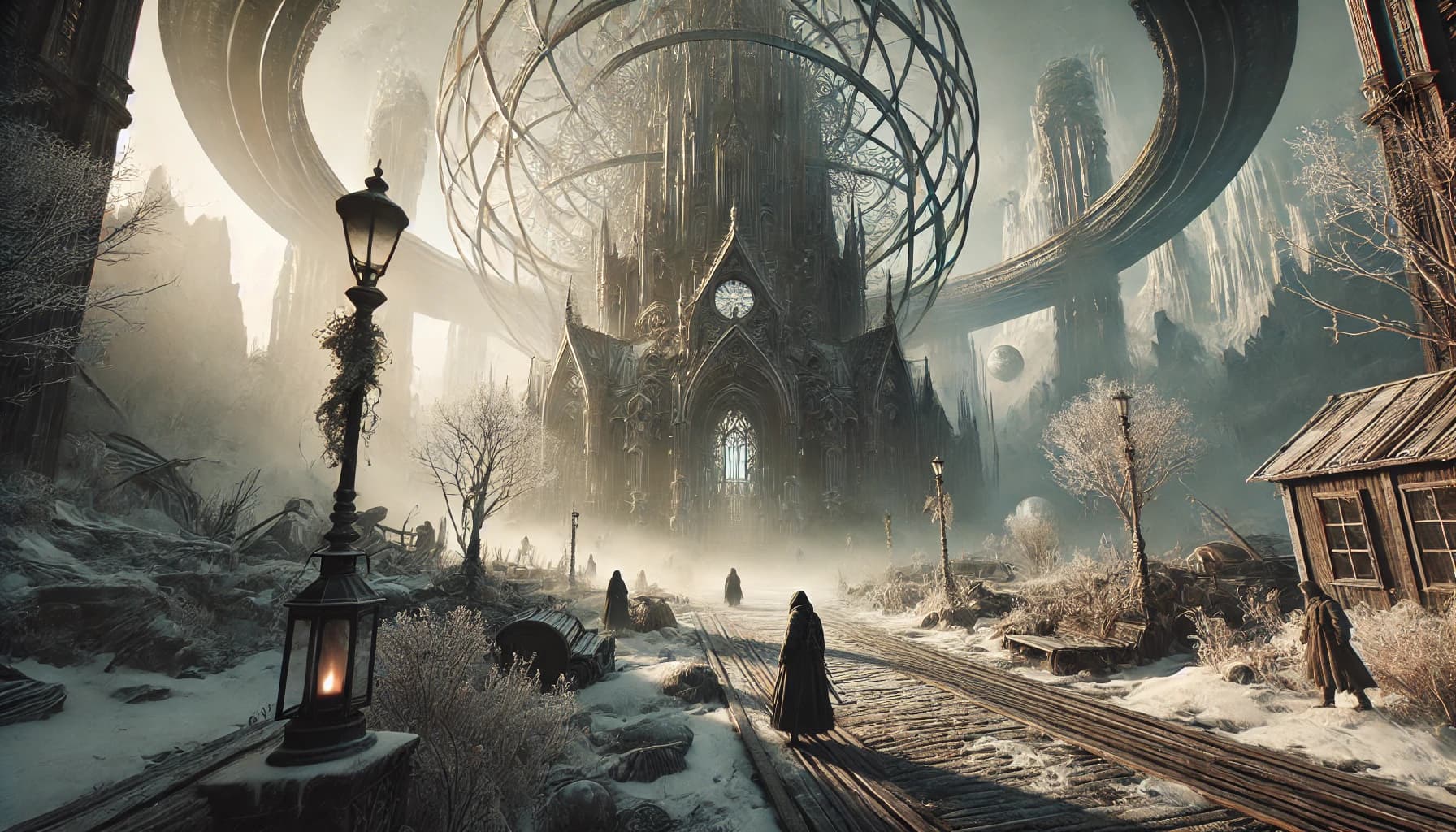
The composition centers on a snowy gothic cathedral, partly ruined, partly intact. Above and behind it, a massive armillary-sphere structure rises into the sky — concentric rings on different inclinations, like the celestial-sphere instruments Renaissance astronomers used to map planetary motion. Cloaked figures walk on the snowy ground in front of the cathedral. A cast-iron gas lamp burns at left. A small wooden shed sits at right. The sky is overcast white. Snow has buried most of the wagons and railings in the foreground.
The armillary-sphere reference is precise. Tycho Brahe's Uraniborg observatory on the island of Hven (built 1576) had an instrument like this at its core; Tycho used it to produce some of the most accurate pre-telescope astronomical observations in European history. The sphere in the image is much larger — building-scale rather than instrument-scale — and that scaling is the image's editorial argument. What if the post-apocalyptic civilization in this scene had built itself around astronomy as a religion, and the armillary sphere isn't a tool but a temple?
The combination with the gothic cathedral is unusual. Gothic cathedrals were already a kind of cosmological architecture — the rose windows, the orientation toward the rising sun, the spires pointing at heaven were all astronomical in their own way. A cathedral and an armillary sphere are, structurally, two different ways of organizing space around the question of what's above us. The image stages them next to each other in the snow, with a few human figures wandering between them. Whatever happened in this world to make it look this way, the people who survived seem to be still asking the older question: where do we stand relative to the sky?
This image was imported from the original Slaacr library. The DALL-E prompt was not documented at creation time. It's pending regeneration through the Studio's SAE master template — once that happens, the prompt will appear here as a teaching artifact.