 16:9 · 1792×1024 · DALL-E 3
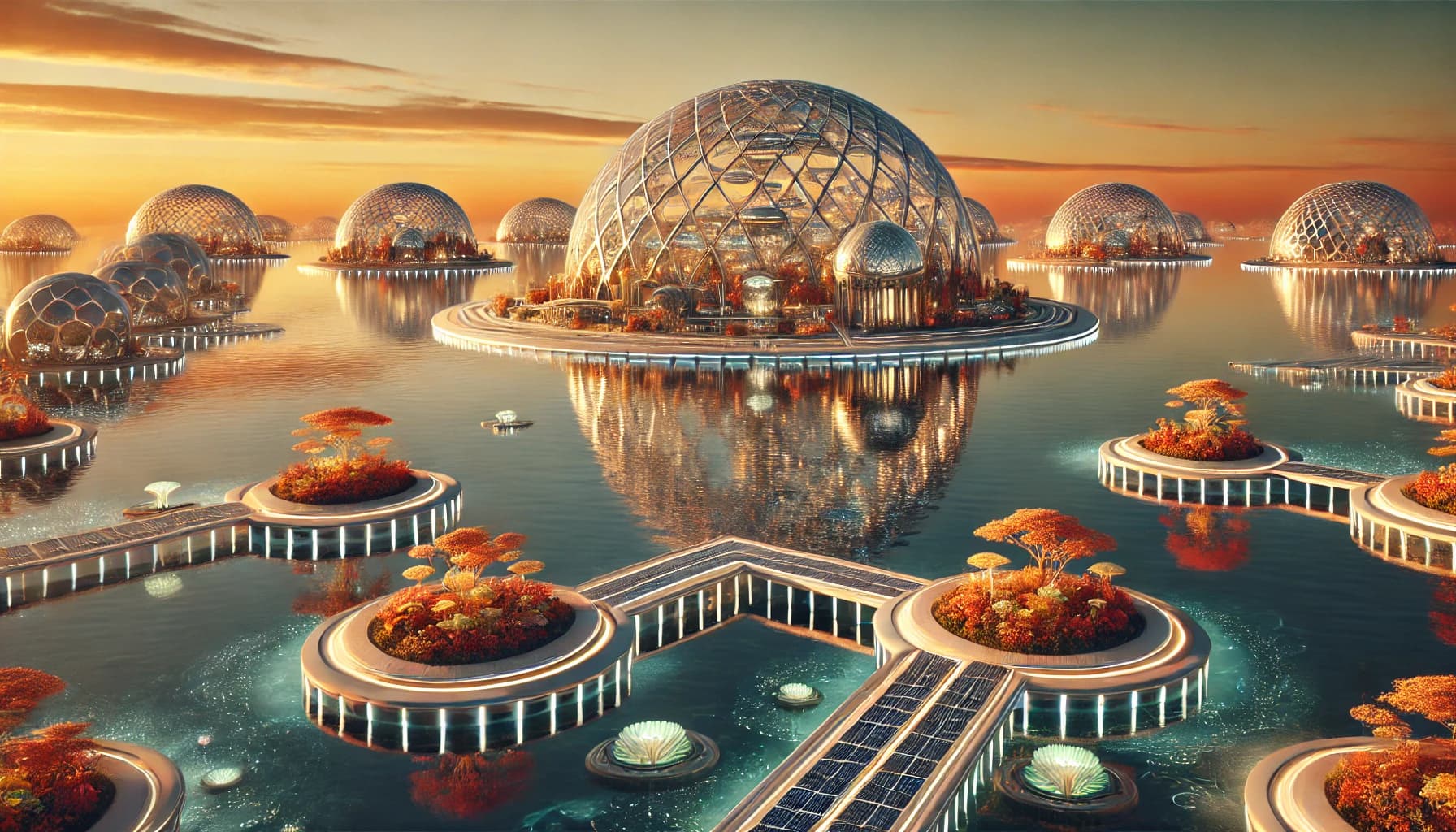
The image is the gallery's quietest. Geodesic glass domes sit on small artificial islands, the islands are platforms slightly above the waterline, and the platforms hold autumn foliage that's reflected back in the water everywhere they aren't. The solar panels are present — a walkway in the foreground holds a small array — but they're not the subject. The water is.
Geodesic domes have an underrated history in eco-architecture. Buckminster Fuller's 1949 Montreal Biosphere remains the most famous; smaller domes have been used in arctic research stations, the Eden Project in Cornwall (the world's largest greenhouses), and as housing in the disaster-recovery experiments of the 1970s. They're efficient — the sphere has the lowest surface-area-to-volume ratio of any shape — which means less material for the same enclosed space, and less thermal exposure for the inhabitants.
What the image proposes is using that efficiency on water. Floating platforms have a long technical history — the Netherlands has built floating houses since 2002, Norway has experimental floating offices, the Maldives is planning entire floating districts — and pairing them with geodesic enclosures gives you a settlement type that doesn't displace land, doesn't require deep foundations, and adapts to sea-level changes by simply floating higher. The autumn timing here is a styling choice. The argument is structural year-round.
This image was imported from the original Slaacr library. The DALL-E prompt was not documented at creation time. It's pending regeneration through the Studio's SAE master template — once that happens, the prompt will appear here as a teaching artifact.