 16:9 · 1792×1024 · DALL-E 3
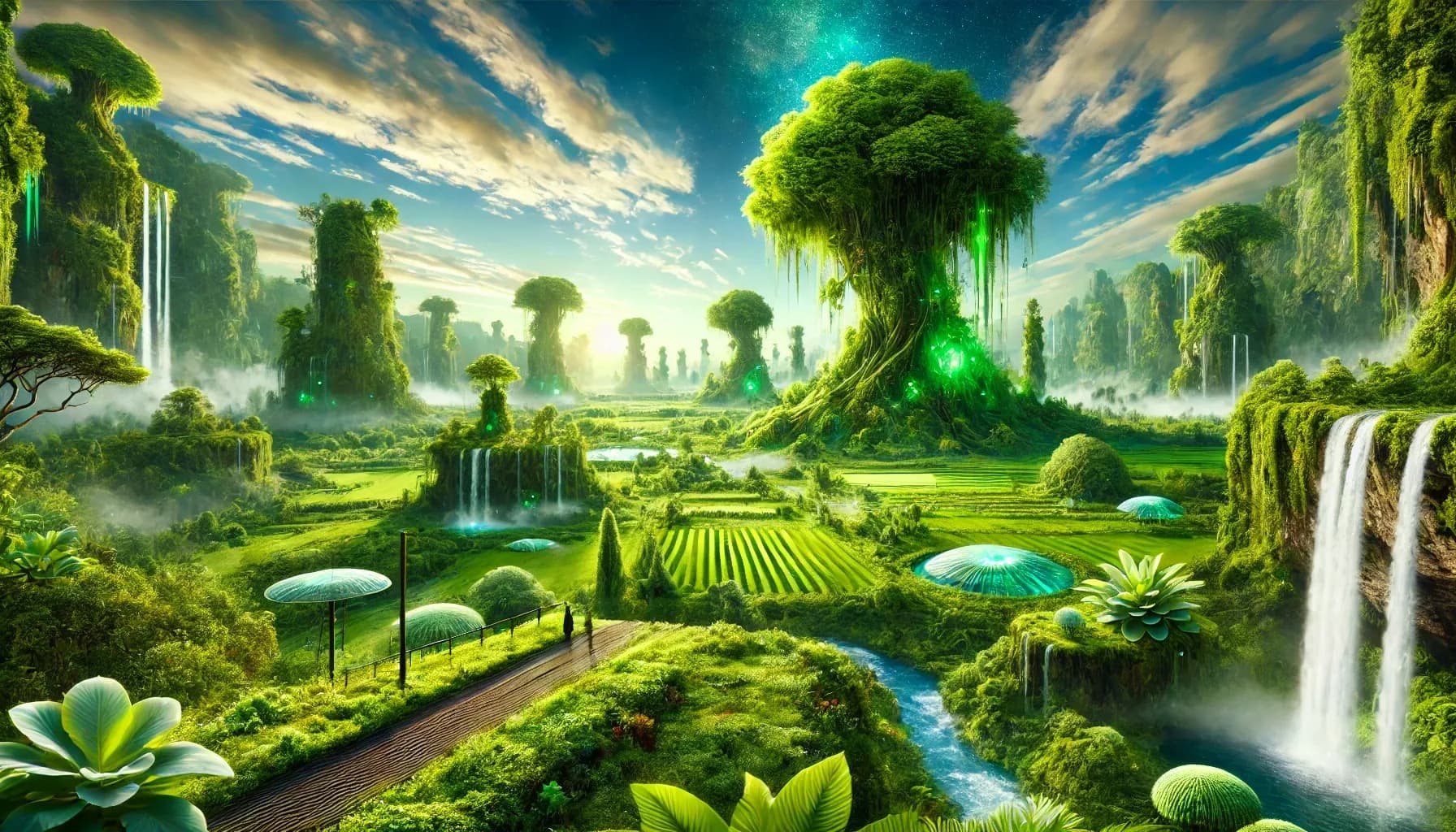
The structures in this image read as trees. Not 'trees integrated with architecture' or 'buildings shaped like trees' — actual trees, with bark and roots and leaves, that happen to be at building-scale and that have been allowed to host human habitation in their canopy or trunk. Several of these tower-trees rise across the valley, their canopies spreading to building-roof-sized broad surfaces, vines and hanging mosses spilling down the sides. Waterfalls drop from cliffs at left and right. Terraced agricultural fields pattern the foreground. A small figure walks along a path between fields.
The biological premise has real-world precedent at smaller scale. Banyan trees (Ficus benghalensis) regularly reach circumferences of 200 feet or more and can host platform-built dwellings or shrines in their crowns; the Great Banyan in the Acharya Jagadish Chandra Bose Indian Botanic Garden in Kolkata has a canopy of over 14,000 square meters and is functionally one tree that has become a forest. Various 'tree-house schools' in rural Java and Bali use existing huge ficus trees as the structural anchor for elaborate platform classrooms. The image extrapolates: what if everything in the village did that?
The tower-trees do what conventional buildings do — provide enclosed space, vertical organization, weather protection — but at the cost of being, individually, alive. That cost is also the appeal. A tree-building grows on its own schedule, dies on its own schedule, can't be retrofitted. The image's argument seems to be that some kinds of architecture might be better treated as collaboration with biology rather than imposition on it. The terraced fields in the foreground are the human contribution. The trees are the partnership.
This image was imported from the original Slaacr library. The DALL-E prompt was not documented at creation time. It's pending regeneration through the Studio's SAE master template — once that happens, the prompt will appear here as a teaching artifact.